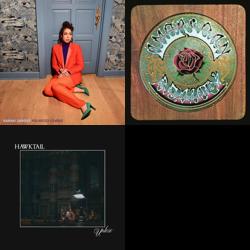
In just a few weeks of self-hosing a Navidrome server that I’ve also made accessible from outside my house, I’ve noticed a significant shift in my listening habits. I’m doing so much more re-listening to albums in my collection than when listening to Apple Music.
Apple Music often leaves me with a sense of FOMO – there’s always something else or new to listen to, making it rare to listen to the same album twice. Contrast that to my Navidrome box which has about 150 CDs or so. The collection is growing, slowly.
Each week, I’m enjoying hunting for cheap used CDs to rip that will fill holes in my collection. I’m finding that after I rip a CD and load it up into Navidrome, it appears under the “Recent Albums,” section that I default to. And so I end up listening to those albums a few times a week. It’s a completely different experience to listen to the same few albums over and over throughout the week. I can’t remember ever doing that with Apple Music.
I’ve still got my Apple Music account to support listening on our house full of HomePods, but between Navidrome and Play:Sub, I’m really enjoying digging into a collection of music that I own. Some of these albums I’ve had for ages and it’s great to revisit them like old friends. (I’ve got on a Cannonball Adderley album that’s been in my collection for probably 30 years at this point—it’s amazing how quickly I can recall his solos on certain cuts).
A quick tip for my future self and other users: If Navidrome stops syncing with last.fm, simply navigate to the profile->personal link in the upper right corner to troubleshoot.
In his latest issue of galaxy brain, Charlie Warzel dismisses the value of ChatGPT in part because he’s unable to see the value or potential. of ChatGPT, because the ability to control or drive value from the tool is outside the grasp of most humanities types.
A good ChatGPT whisperer understands how to sequence commands in order to get a machine to do its bidding. That’s a genuine skill, but one that eludes me as well as some other humanities types I know. The best ChatGPT prompters I know tend to be good systems thinkers or at least well-organized people—the kind who might create a series of automated protocols and smart-home integrations to turn their lights on and off. I’m the guy who sees romance in wandering around in the dark, bumping into a coffee table, to find the switch.
I would argue that “humanities types” are some of the most well-positioned to be able to exploit the value of chat, GPT, and other large language models. Humanities types as he refers to them, understand language and its power of precise language more than most. The ability to construct exactly the right language or prompt is one of the key skills needed to extract value from chat, GPT.
Trying to track down the origin of a quote this morning, I learned about something called the Matthew Effect, inspired by this verse from the Bible:
For to everyone who has, more will be given, and he will have abundance; but from him who does not have, even what he has will be taken away. – Matthew 13:12
Coined by sociologist Robert K. Merton in 1968, it describes the phenomenon where recognition and success are more likely to be bestowed upon those already distinguished, reinforcing their status. This concept, particularly relevant in science and academia, notes that well-known scientists often receive disproportionate credit for their work compared to lesser-known counterparts, even if their contributions are of equal importance.
This leads to a cycle where established figures gain increasing recognition and resources, exacerbating disparities in visibility and success. The Matthew effect extends beyond academia into fields like economics and information dissemination, reflecting the broader impact of social and professional networks on career advancement and recognition. It also highlights the challenges faced by emerging talents in gaining acknowledgment and success.
Noting here because it has so many implications, it’s something that I had a sense of but now that I have a term for, I’ll be more aware of.
Recently, I’ve come across discussions online debating the role of AI-generated visuals in the art world. Some argue that AI poses a threat to professional illustrators and advocate for its limited use in creative processes. While I understand these concerns, I’m trying to understand my perspective a bit here, and I’d like to explore this through an analogy.
I’m thinking specifically about the advent of synthesizers and sampling in music, which perhaps parallels the emergence of AI in visual arts. This comparison highlights a dynamic tension between tradition and innovation, and between human creativity and technological assistance.
Personally, my preference runs towards the sounds of acoustic guitar. However, this preference doesn’t lead me to dismiss music that incorporates sampling or synthesized elements*. While I’m not convinced that these technologies have inherently enhanced music’s quality, they have expanded the creative toolkit available to artists. Music rich in synths and samples, to me, exists in a universe distinct from universe I inhabit when I strum my Martin guitar.
AI-generated art, like synthesized music and sampling, opens up new creative avenues that might be unattainable through traditional methods. Almost certainly AI will impact the livelihoods of some artists, similar to how synths and sampling reshaped the music industry. But it’s important to recognize that these technologies also democratize creativity, enabling more individuals (for better or worse and with widely varying degrees of artistic quality) to express themselves.
I believe that mastery in music should require the ability to create great music without relying on synths or samples. Likewise, artistic greatness probably shouldn’t rely completely on generative AI. Art and music should foster inclusivity and diversity and they should celebrate individual creativity and autonomy. For me they should not require an over-reliance on technology but that’s not to say it shouldn’t be a tool in toolbox.
*I have an album that I’m working on releasing of mostly synthesizer music, so, again, I don’t think there’s anything wrong about synths or sampling.
I am not a big fan of the Subaru app. It’s janky but does offer a way to remote start my car. But, as the days are getting colder, I’ve been thinking how nice it would be to be able to tell my bathroom HomePod Hey Siri, Warm up my car. So over lunch today, I managed to cook up some shortcuts to start/pre-heat, stop & lock my 2023 Outback.
I’ll also note here that I am confirming that this does in fact work with the ‘23s as some folks on the Subaru formus were having problems but those problems are not related to the model year.
Obligatory Dall-e Outback/Apple art
You need to make sure to get your deviceid AS WELL AS your PIN entered in to the shortcut.
Good instructions for getting your deviceid found here from https://www.subaruoutback.org’s TheyDroppedMe but I’m pasting below because I have no faith that anything linked to on the internet will be here tomorrow:
First of all, you’ll need to use the Chrome browser on a desktop for this.
1) Open chrome and go to www.mysubaru.com/login (DON’T login yet! If you’re already logged in, log out and go back to the login page) 2) Right click on the page and select the inspect option at the bottom. This should open the chrome dev tools in a frame to the side or bottom of the tab. 3) On the top bar of the dev tools section, you should see options like Elements, Console, Sources, Network, etc. Select the Network tab (you may have to scroll over to see it). Once in the Network tab, click the Preserve log checkbox. 4) Now on the mysubaru web page next to the dev tools, enter your login information and login. You should see a flurry of activity in the Network tab 5) Scroll down in the left-hand column in the Network tab until you see an entry named login and select that. On the box to the right of that column, select the Payload tab and you should see some data under Form Entries that contains your vehicle ID, device ID, username, and password
Importantly there are different URL components for the different services:
engineStart
engineStop
lock
unlock
It’s been really nice to not have to use the super-tedious Subaru application. I already the Hey Siri, warm up my car before heading out to the gym this afternoon. So cool.
I’m not really sure that I use genre information too much in organizing my library, but that’s not to say that I don’t want it to be correct when it’s applied.
My years working in the classical music world taught me how painfully insufficient existing music metadata tagging is for classical music — e.g. movements and composers and conductors matter a lot and are such a challenge in Apple Music that Apple released a classical-only app that admittedly does a really decent job handling the complexity of classical music metadata.
As I’ve been ripping some legacy CDs into lossless over to my Navidrome box, I’m laughing at the default tags applied to the CDs as they’re ripped. Everything from Emmylou Harris to Asleep at the Wheel to the Stanley Brothers gets categorized as “Country & Folk” which is crazy. Western Swing which isn’t even an option in Apple Music. I’m not saying Country has the same attribute complexity as classical, but from an organization/genre perspective there are definitely some nuances that could be captured better out of the gate.
From what I can tell, Apple uses Gracenote to pull in metadata and genre info. MusicBrainz gets a bit closer, calling the Bob Wills tribute album “Country” with the default scan and does offer the ability to customize how genres are handled. I could choose to include or exclude certain genres, or set it to only use specific genre tags.
Might need to bake these in to Apple Music/Navidrome:
Bluegrass
Bluegrass/Country Gospel
Traditional Country
Honky Tonk
Outlaw Country
Country Rock
Country Pop
Western Swing
Rockabilly
Cajun and Zydeco
The real question though is what to do with what the Country Music establishment refers to as “Americana” which is really Country, whereas the “Country” pushed by the Country Music establishment is best defined as bro-Country or maybe jingo-Country?
Experimenting with Linode, S3 storage and Nextcloud to see if I can find an easy way to link to music I want to share.
While bluegrass, country and Dead are my primary musical outlets, I like to switch gears (ha, that’s funny in a way that will be clear in a minute) and play with synthesizers and drum machines.
I am a huge fan of the show High Maintenance and love the shots where the the Guy is riding his bike to sound of low-fi electronic music as I, too, love to listen to electronic music when I ride my bike around town. So I switch gears from acoustic music and fiddle around with making electronic music. Here’s a sample
Note, this hasn’t been mastered or anything so volume may be weak.
Curious to see how functional this link is. Do you find it easy to download if you want? Or is it ok just to make it streamable?
Spent my lunch hour researching ABLE accounts with ChatGPT4. Overall positive experience (I sanity-checked the results). Some interesting findings:
The average annual maintenance fee for ABLE accounts, considering a range of states, is approximately $42.67. This is based on the fees of several states, which generally range from $35 to $60.
NJ’s program offers ZERO tax incentives for NJ residents.
Virginia’s ABLEnow has no opening fee and waives the monthly fee if you maintain a $10k balance.
Accessing funds is an important feature, Virginia’s ABLEnow program has a debit card as well as no monthly fees.
The ABLEnow program offers several investment options for account holders:
Aggressive Growth Portfolio: This portfolio invests entirely in the Vanguard LifeStrategy Growth Fund. It primarily allocates its assets to common stocks (about 80%) and bonds (about 20%), making it suitable for account holders with a higher risk tolerance.
Moderate Growth Portfolio: This portfolio is invested in the Vanguard LifeStrategy Moderate Growth Fund. The allocation here is approximately 60% in common stocks and 40% in bonds, offering a balance between growth and income.
Conservative Income Portfolio: This portfolio focuses on the Vanguard LifeStrategy Income Fund. It is more conservative, with about 80% of its assets in bonds and 20% in common stocks, catering to those who prefer lower risk.
Money Market Portfolio: This option invests in the Fidelity Investments Money Market Government Portfolio. It’s a very low-risk option, with at least 99.5% of the fund’s total assets in cash, U.S. Government securities, and fully collateralized repurchase agreements.
I’m regularly struggling to get my iPad recognized by my Mac for Handoff and Keyboard/Mouse sharing. I like to be able to use a single keyboard and mouse to dive my computer and my iPad, located next to my Mac monitor.
Even after making sure that they’re on the same network and signed in with the same iCloud account, the Mac will often not “find” my iPad. Here’s a solution I’ve stumbled upon to get it to work.
iPad: Open up Settings on the iPad and turnoff Handoff (under General->Airplay & Handoff).
Mac: Open Settings->Displays. Click “Advanced…” and uncheck “allow your pointer and keyboard to move between any nearby Mac or iPad.” Click “Done” (important!)
iPad: turn Handoff back on. Make sure to toggle “Cursor and Keyboard” On.
Mac: Click “Advanced…” again. Toggle “Allow your pointer …” back on. I keep the other two options (Push and automatically reconnect) enabled as well.
On the Mac you should now be able to find you iPad under the dropdown with the + symbol and select “Link keyboard and mouse to” your iPad.
Good luck getting them arranged in any kind of convenient way though! I still can’t get that to work as expected consistently.
In addition to catching Lucas Nelson + POTR at the Ryman, we saw a bunch of other great music, here’s a run down. This doesn’t include any details about the killer guitar shops we checked out, I’ll try to write some of those notes up.
My nephew and I landed in Nashville, dropped our bags at the hotel and took an Uber downtown to see what’s what. We lucked out getting picked up by an Uber driver who was a flatpicker/bluegrasser and he dropped a lot of local knowledge on us, all of which turned out to be spot-on.
The best intel he gave us was about Robert’s Western World. Robert’s seems to be Broadway’s last true showcase for great country players.
Our first taste of this was when we walked in to Robert’s and heard a pedal steel player playing with the Paul Kramer band. Super high level of musicianship from everyone on stage.
Kelley’s Heroes/Luke McQueary
The real mindblower came the next night at Robert’s when we encountered Kelley’s Heroes. We didn’t know it at the time but the name stems from the players having all come out of Don Kelley’s band. Kelley’s band was a Nashville institution that churned out a string of amazing guitar players including folks like Brent Mason and Daniel Donato.
Luke McQueary was the guitarist we saw with Kelley’s Heroes at Robert’s. Luke was Don’s last guitar player (this video is Luke talking a lot about what he learned from Don and it is all gold if you’re a guitar player). We all recognized that we were seeing something really extraordinary in how this cat was playing his tele. Thumbpick + great blues chops + killer Tele tone. So great watching this guy play. Every note was compelling, we will all be keeping our eyes on this guy, he’s something for sure. Check him out doing Ghost Riders in the Sky to get a flavor for his sound.
Don is a fascinating guy who shaped so much of the telecaster sound that is currently associated with country/americana, this long video interview is totally worth checking out. If you’re so inclined, every player that’s come through Don Kelley’s band is worth checking out here are a few:
Guthrie Trapp (I took some online lessons with Guthrie. Great player.)
Brent Mason
David Byrd
Paul Cook
Sid Hudson
Johnny Hiland
Daniel Donato
JD Simo
Stuie French and Rory Hoffman
Wendy Newcomer’s band brought a slightly more chill vibe to the Robert’s daytime stage. The band had Stuie French on Telecaster and Rory Hoffman on everything. First, Stuie. Man, this guy was coaxing the most pedal-steel sounds out of his telecaster, working the chord voicing to mimic 6th chords and the volume swells, dude knew where it was at. We knew Stuie was a monster but it wasn’t until we got home that we realized he’d played with a whole bunch of great players like Tommy Emmanuel .
We also straight away took notice of Rory Hoffman. It was clear that Rory is blind and we were just totally blown away by his playing on accordion and singing and then when he laid a guitar across his lap he just lit us up with his chops. Here’s a video of Rory backing up Sierra Ferrell.
Who profits from our constant state of dissatisfaction? The answer, of course, is painfully obvious. Every industry that sells a solution to a problem you […]
. The EU invokes a mechanism called the precautionary principle in cases where an innovation, such as GMOs, has not yet been sufficiently researched for […]
The real problem, in my mind, isn’t in the nature of this particular Venture-Capital operation. Because the whole raison-d’etre of Venture Capital is to make […]
Saved Links
RSS Error: A feed could not be found at `https://links.jimwillis.org/feed/atom?`; the status code is `404` and content-type is `text/html; charset=utf-8`